Wednesday, May 9, 2018

Tour de France with the Blantons:
Round 1

Around Christmas, my parents and three siblings compared their varied schedules and found a single week in the spring where they were all free to visit us in France.  From then on, we counted down the days to April 21st from both sides of the Atlantic.

Finally, winter ended and the arrival date approached!  Nico and I were approved to borrow the community car as we needed it during the weekend of their arrival and we made our way to the Quimper train station by 4:15pm on Saturday, April 21st to watch their train come in at 4:30pm.  The "arrivals" screen showed their train à l'heure so we quickly found the correct platform and joined a small group of other eager people, posed like prarie dogs facing left together, watching for the nose of the train to appear around a curve.

Soon enough, we heard a whistle!  We giddily waved as each car passed until, towards the end of the train, we saw three of the five familiar jet-lagged faces peering through a window with amused smiles as their hands waved back at us on auto pilot after 24 hours of sleepless travel.  What joy!  Those of us easily prone to tears had watery eyes as we hugged and gathered all the luggage.

The following photographs are a mixture from all of my family's cameras.

Day 1: Saturday, April 21st

My family's arrival at the train station!


Day 2: Sunday, April 22nd
Catholic mass and Medieval Locronan

Instead of driving into town for the mass on Sunday morning as usual, we
joined the Ark on a stroll to the small local chapel in the town of Saint-Joseph.
The chapel is only open one day per year in honor of Saint Joseph's day, and
was packed, with overflow benches just outside the door. On the left in this
photo, tables were set up where you could get a drink of Kir (sparkling wine
with black currant) or Cabernet d'Anjou after the mass. While the mass was
still being played out, a small crowd of pre-gamers had gathered, maybe
because the chapel was so packed they couldn't get in... or maybe not.

We ate at a local crêperie on the beach for lunch, highly recommended by
Christiane and Robert. As you can see in the reflection in the window... we're
really right on the beach. By the way, that's Lara Mack! She had a small window
of time where she could visit us, that happened to overlap with my family's visit.
We joyfully welcomed her for the 36 hours or so that she was able to join us. :)

On the way to the Quimper train station where we would part ways with Lara,
we stopped to walk around Locronan - our favorite nearby old medieval town.
(See Kishiah's visit for the interesting history of Locronan.)


Day 3: Monday, April 23rd
A day at Guenvez

My family hung out in the bakery for a little while and watched Nico pulled
pizzas out of the oven and slide all the bread in.

Lunch in the communal kitchen.

Nico and Sylvain (Benoit's brother) took my family
grocery shopping at Géant.  This is the USA section of
the international aisle.  Click on the photo to get a window
into France's understanding of United States cuisine.

Nico took my parents and siblings on a tour of the farm while
I packed up our family to join in on the France sightseeing tour.
Moisés and Yanni show the onions
in the market garden beds.
Nico, Moi, Yan, and Josh pose in
front of a silo, "to show how big it is".


Day 4: Tuesday, April 24th
Medieval Dinan


After rolling out of Guenvez a little later than we had hoped, our
first stop was the medieval town of Dinan. Here, some tourists
pause under an arcaded building to decide where to go next.

A section of Dinan's fortification wall still stands, including this governor's tower
from the 15th century. No longer necessary, the barricade provides a nice hike
through the modern city of Dinan with beautiful, sometimes nearly 360 degree views.

After Dinan, we drove to an AirBnB near Mont-Saint-Michel.  The house
was a duplex, with the owners living in one side and providing the other
side for travellers and vacationers.  They had several baby goats, chickens,
and a handful of rabbits which the boys loved!

We heard that Mont-Saint-Michel is beautifully lit up at night, so a handful
of us tried to go see it.  But it was late and we were tired, so we didn't want
to put in too much effort, as in, park the car and ride a 10 minute bus.
This was as close as we could get... hah.


Day 5: Wednesday, April 25th
Le Mont-Saint-Michel and Normandy Beaches

Le Mont-Saint-Michel

Le Mont-Saint-Michel at low tide.  Apparently the land is so flat, that the tide
advances and receeds at 18 feet per minute.  Before the bridge was built, it
was truly a pilgrimage to cross the sandy bottoms to the famed island.


Because of the pointed shape of the top of the island, many "crypts" were
built over the uneven surface, their roofs creating level ground on which to
construct the cathedral.  Marj and Moi hug two of the massive pillars
that bear the weight of the cathedral above.


A couple stragglers still chowin' down in the mess hall. 

Yep, this is what it looks like: a human-sized hampster
wheel.  While Mont-Saint-Michel was used as a prision
from 1791 to 1863, six prisoners would climb in and
walk two-abreast to power this wheel, lifting supplies up
to the abbey area from below.

Inside the church.
Moisés ponders in a side chapel.

On our way out, looking up at the cathedral from below.
There is a golden statue of Saint Michael on the point of the
spire. It is said that, early in the 8th century, Saint Aubert of
Avranches had visions of Saint Michael telling him to build
an oratory on what was formerly Mont-Tombe.  Saint Aubert
ignored the first two of these visions, and finally on the
third one, Saint Michael pressed his thumb into Saint
Aubert's forehead and left a mark.  So... he built the oratory.


Normandy Beaches

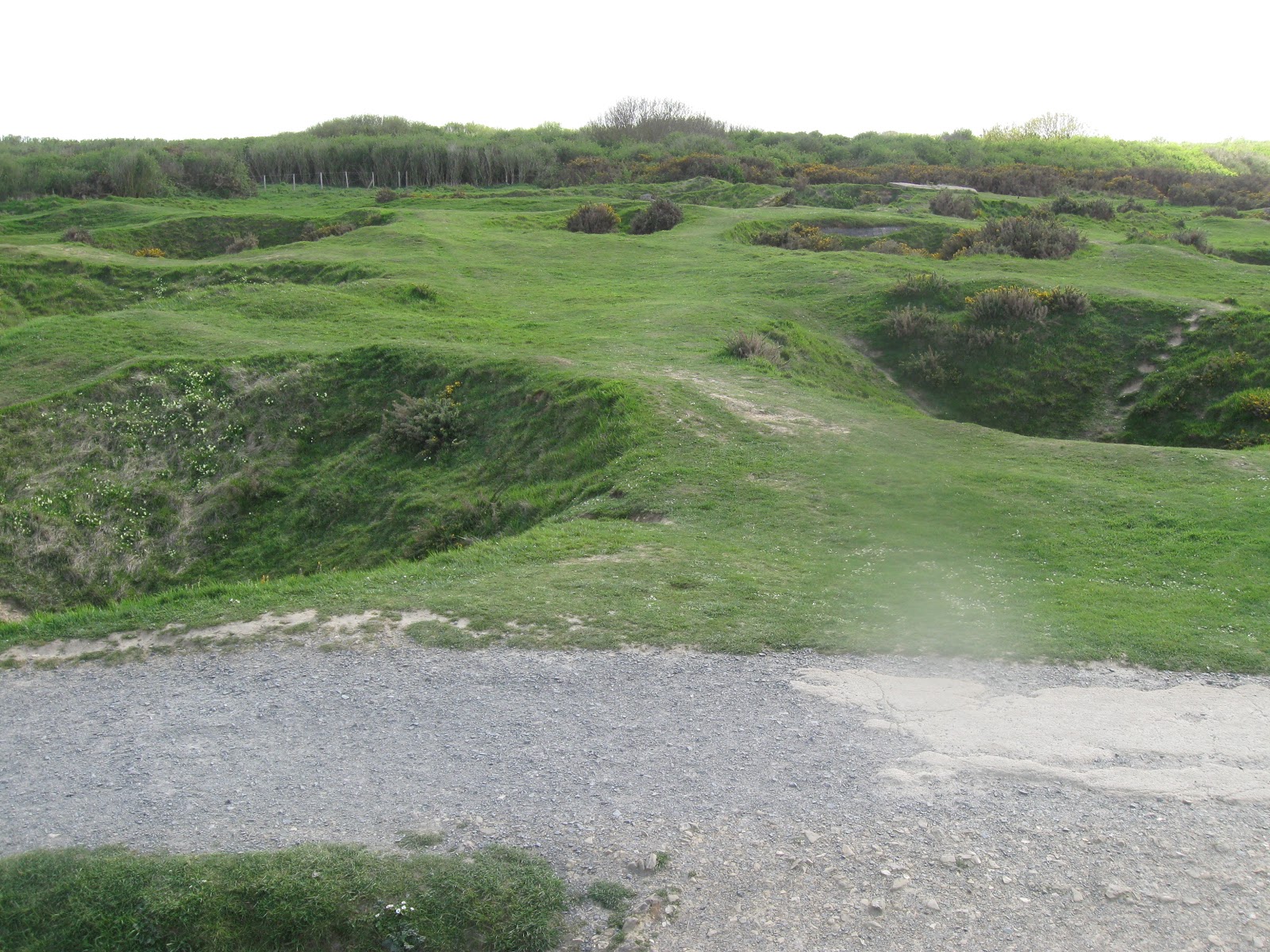
On the way to Paris we stopped at Pointe du Hoc, one of the American
landing points on D-Day. We were stunned to see the "moonscape"
still remaining from "10 kilotons of bombs - with nearly the
explosive power of the atomic bomb at Hiroshima - but
dropped over seven weeks"1 in pre-D-Day bombing efforts.

The cliffs of Point du Hoc.  Troops had to wade through the ocean
from their boats and haul their wet bodies up ropes and ladders,
backpacks and all, with the constant threat of gunfire from above.

As time heals all wounds, Omaha Beach is fronted by fancy vacation
homes up to the left, tucked into a large hill that runs parallel to the beach.
After walking around the bomb scars at Pointe du Hoc and watching a short
film in the small museum there, which shared some of the grave truths of
the famous military event, it was hard for us to imagine it had become a
vacation destination. We all felt the weight of the history of the landscape.


Day 6: Thursday, April 26th
Paris

In the morning, Ben, Marj, and Josh went to Musée
d'Orsay while the rest of us took it slow to recover from
the late night travel into Paris.  Here is a famous historical
painting of Ben when he's a little older.


We strolled along the Seine on the way to the Louvre.

The courtyard of the Louvre!  Inside the grand glass pyramid it is hot,
as you might expect something built like a greenhouse to be.
(Click on the photo to enlarge it.)


On our way home from the Louvre, we stumbled upon Pont des Arts,
one of two famous bridges where lovers prove their amour by attaching
a padlock to the bridge and tossing the key in the river.  *Sigh*, we are
actually posing.  Though we love each other, we did not choose to
purchase a lock from the advantageous vendor in the middle of the bridge.

We also stumbled upon Thomas
Jefferson strutting the streets of Paris!

Our day ended at the Eiffel Tower.  Here is my family of origin at the top...


...and my family of posterity at the bottom.


Day 7: Friday, April 27th
Versailles

We spent all of Friday at Versailles, palace to King Louis XIV, a power-hungry control freak who pacified nobles with grandeur and arrogantly proclaimed, "L'etat, c'est moi!" (The state, that's me!). Halfway through his reign, around the year 1700, Louis XIV had put so much of his time and energy and the public's funds into Versailles and himself, that he had elevated France to the culture and power hub of Europe. Our guidebook told us that at that time, "throughout Europe, when you said 'the king,' you were referring to the French king - Louis XIV."2

Breakfast in the café of Hôtel Beaugency in Paris.

The somewhat sickening splendor of Versailles still draws people from all
over the world... the line in this photo flows all the way to the golden gate,
then curves to the columned building on the left. Etched across the top of
both roman-style buildings are the proud words, "A TOUTES LES
GLOIRES DE LA FRANCE", that is to say, "to all the glory of France".

That is a cat in a backpack.
King Louis XIV couldn't have imagined this himself.

Spending freely from public funds, Louis XIV transformed his father's
hunting lodge - a place that held his own favorite childhood memories - into
the elaborate palace of Versailles, as a get-away from the hustle and bustle of
Paris.  Every inch of the gigantic palace is intricately decorated, such as the
fireplace pictured above in the Hercules Drawing Room.


Papa and Moisés listening to the free,
and very well done, audio tour.

This is a baby in a backpack. :)
The timing of Yanni's nap allowed me
to peacefully read every plaque and
hear every second of the audio tour.

The self-proclaimed "Sun King", Louis the XIV ate his dinners at the white
table while members of the high court would sit on the red cushions and watch
him, commenting on his every movement.  He had a strict schedule to the day,
requiring people to be present for his waking up and going to bed ceremonies,
in addition to this dinnertime ritual.

This room is dedicated to the French Revolution and beyond, which made us
question why the palace of Versailles was not destroyed in the revolution.  The
National Convention - the first goverment after the revolution - decided to
claim the palace as property of the Republic to use as a public space, turning
Versailles into a museum in 1794.  Over the last 200+ years, though the
government has changed hands and the role of Versailles within each new
reign has shifted to and fro, the expansive palace has basically kept it's
status as a public space and museum.

Our first view of the extensive gardens surrounding the palace.

Louis XIV had the Seine River re-routed to water his lavish gardens and fuel
the 50+ fountains scattered throughout the grounds. Here, Yanni and Marj
watch a fountain show. The spurts of water are timed to correspond with
classical music blasting from hidden speakers all around - something only
possible in modern times, yet still certainly within the spirit of Louis XIV.

Marie Antoinette was intrigued with peasant life, though
perhaps not interested in either starving or doing the actual
work herself, and had an ideallic, fully-functioning village
built in the woods near Versailles. She and Louis XVI
retreated into their extensive fantasy worlds 60 years after
Louis XIV, and far away from the ever-more-discontented,
near-revolution public. As the kingdom of France crumb-
led at the end of the 18th century, the ruling class continued
to invest in more toys and luxuries with public funds.

When political life followed Louis XIV to Versailles, he built another lavish
retreat to get away from his first one, only a short walk from Versailles.
Referred to as the Grand Trianon, it is much smaller than Versailles: comprised
of "only" two ornate wings, connected with the colonnade pictured above.

A great way to end a big day on our feet... and our week-long trip together!
The next morning, we would all part ways.

____________________________________________________________

1 Steves, Rick. (2017). France 2017. (p. 285). California: Avalon Travel.
2 Steves, Rick. (2017). France 2017. (p. 178). California: Avalon Travel.

Thursday, March 8, 2018

Our first visitor!

Yanni saw Kishiah reading and climbed up next to him to
read his own book.  Yanni loved having a visitor stay with us.
We were delighted to host our first visitor last week: Kishiah of the Brothers & Sisters, as we've come to call them.  This is the same band of Christians I mentioned earlier in this blog, when Yehuda helped us safely traverse NYC on the busy subway with our seven bags and two children.  This particular group of faithful Christ-followers began in the 1970s and has been US-based until recently.  In the last few years, they've begun exploring missions opportunities overseas.  Kishiah was the first of the Brothers & Sisters that we met, nearly eight years ago in Charlottesville at Random Row Books (RIP community-building bookstore!) on our second annual Petrol-Free bicycle tour (RIP community-building bike ride!).  In light of his group's international growth, Kishiah had just received his first-ever passport in the mail when he heard that we'd actually pulled it off: we were in France.  On the phone, Nico heartily invited him to visit us and without hesitation, he said, "Yep. Yeah. I'm gonna do that."

Nico found him at the Quimper train station on Sunday afternoon, February 25th, and he stayed with us until Monday, March 5th.  He joined the community's weekday rhythms as much as he could while recovering from jetlag.  On Saturday and Sunday, we borrowed a car to tour the surrounding area... going a few places our family hadn't been able to see ourselves!

First driving experience in France!
The rules are different and the roads aren't labled.


First we made our way to the medieval section of Quimper to look for the beautiful cathedral we'd heard about.  We found it right away... or so we thought.  As you can see below, it was just a simple "church".  I've been learning a lot about Catholicism while here in France and I have been surprised that the cavernous, ornate buildings we've been to are mostly not referred to as "cathedrals", this word is reserved for the gigantically cavernous, intricately ornate structures.

Eglise Saint Mathieu, built in 1896
to replace a church from the 16th century. 


Winding our way through a well-preserved part of town (note the structures
on the left, possibly restored from centuries past), we found the cathedral!


The construction of the Cathedrale Saint-Corentin
began in 1424 and it's been added to ever since.


On Nico's shoulders, Moisés approaches the elaborate entrance.


The enormous, echoing, interior cavern of Cathedrale Saint-Corentin.


One of many thoughtful, detailed stained-glass
windows: the passion story, left to right, bottom to top.


Saint Francis.  His book reads: Quittez tout. Vous
trouverez tout.  (Leave everything. You will
find everything.)


Family photo on the Steir River in Quimper.


On the way home, we stopped in Locronan, a small town still intact from the middle ages.  Buildings have dates from the past several centuries etched into their corner stones, and many are certainly older still.  From wikipedia:
The village's name means the "hermitage of Ronan", from the Breton lok which means hermitage, and after the eponymous founder Saint Ronan. It has previously been known as Saint-René-du-Bois
Saint Ronan is greatly venerated in Brittany. He was an Irish Christian missionary of the 6th century who came to the region to teach the people. As his association with Locronan is close, some of his relics are kept in the parish church.  
Since the 15th century, hemp has naturally grown in the area. It was cultivated and processed in a hemp industry in the town at the time, and it was widely used. The town was quite prosperous. Its hemp was exported internationally, as it was used for rigging the ships, both commercial and military, that operated from Brittany's many ports.

Walking into Locronan.  The closer you walk to the impressive
church building in the center, the older the buildings date.


Eglise de Saint Ronan, built between 1430 and 1480.


The door is modern, but the lintel is not.  The words
are probably Breton, certainly not French,
suggesting that the establishment was open and
running in the 18th century or earlier.


This appears to previously have been something else...


Note the thick vine that crawls across the building and around the corner!


Thursday, March 1, 2018

Pancakes in Crêpe Country, and other first quarter cultural tidbits

If there's one thing people in France are known for, it's their food.  And alongside the food comes a rich culture delineating how to prepare and eat it properly.

In late December, we hosted a French couple for dinner in our little apartment.  In a sense, this is easier done than said, since the lunch cook makes a simple soup for dinner while they're prepping the midday meal.  I simply fill my family-size pot from the large stockpot and reheat.  Ironically, Blandine, the wife of the French couple, happens to be a trained chef and baker, and had offered to cook the day we had planned to share dinner.  Therefore, after welcoming her and her husband Paul into our little home, we then chuckled, asking, "So... what's for dinner?"  Since Blandine had prepared our main course, who was hosting who after all?  :)

In France, a rich food heritage brings connection and shared understandings across the country, but it can sometimes be limiting, too.  For example, no beet soup.  Christiane (from Germany) recounted a memory from early on in her experience living at the Ark, in the mother community in southern France.  At some point the community found themselves swimming in beets, which are almost always grated and served as a raw salad.  In trying to find creative ways to use the fresh, plentiful produce, Christiane whipped up a tasty soup... and no one ate it.  That is not what you do with beets.

On the other hand, an onion-based soup is culturally believed to be a good idea, but to call it "French" onion soup would be redundant.  Here it's simply known as soupe aux oignons, and French fries as les frites.

Nico makes pancakes for Mardi Gras
by candlelight on a bilig,
Our first encounter with soupe aux oignons was a bit of an amusing cultural clash.  It all started because I wanted to eat pancakes for Mardi Gras and thought the community might enjoy it too.  We all know that Nico is an excellent pancake chef and enjoys cooking for large groups, so I briefly ran the idea past him.  He was open to it, and before we had a real conversation about logistics, it was my turn to be present at the weekly community meeting that we take turns attending.  They happened to have "plan Mardi Gras festival" on the agenda, so I signed Nico right up to make a pancake dinner!  ... :)

They asked me if pancakes are sweet.  "Yes, usually..." I told them, "but it depends what you put on them, I guess..."  Which in hindsight was obviously a silly thing to say.  Of course pancakes are sweet!  Ultimately, the cultural question was not "are they sweet?" but "how can you eat dessert for a meal?"  And the answer shouldn't have been a hesitant "they're usually sweet...", but rather a confident, "yes, they're sweet, it's Mardi Gras!"

This wasn't the first time we had suggested a dish that baffles the French palate.  At the end of last year, one of Yanni's few intelligible words was "pumpkin pie", which is how he referred to pumpkins in general.  I decided to make the classic American favorite as a dessert for a community Advent gathering in early December.  We now have new insight as to why I was then asked to make another pumpkin pie, but as a main dish for the community Christmas meal, and why its popularity was startlingly low.  (See the humorous photo in the Christmas & New Year's post.)

Number 1: Tarte vs. Torte.  A tarte has crust only on the bottom.  It is nearly always savory.  A torte has a second crust covering the top and is nearly always sweet.  After explaining these distinct differences to me, my real live French friend Amélie continued, "And then there are quiches..." and she stopped and laughed.  We didn't get into quiches, that would have been too much.

Number 2: Pumpkins are savory in France.  A sweet pumpkin dish doesn't compute here.

So, though perhaps a savory pumpkin tarte is a comprehensible menu item, an uncovered sweet pumpkin dish is neither a tarte nor a torte.  Neither a main dish nor a dessert.  But to be sure, none of my questionable pie went to waste.  My boys got a kick out of pumpkin pie as a side for every lunch and dinner until it was gone.  :)

I wasn't sure what else was being said about the Mardi Gras dinner at the community meeting, but eventually we moved on to the next topic, so I didn't worry about it.  Unfortunately, due to the language barrier and cultural differences, my waffling about the nature of pancakes was more confusing than I realized.

A few days before the feast, Elisabeth approached Nico to clarify the menu, "So, how does it work? We will eat pancakes, which are sweet? But they're not dessert? And what do you eat them with?"  Nico replied, "I'd be happy to make an omelette in the oven to go with it. You know, breakfast for dinner."  But she couldn't have known, because an omelette is not breakfast food here.  The answer to "breakfast" in France is "bread".  There's even a word for it, tartine, meaning "bread with stuff on top".  And there are, indeed, a vast and wonderful array of tasty spreads, dips, and toppings for bread here!

Nico would've certainly also suggested bacon as part of an American breakfast-for-dinner if we weren't in a vegetarian community.  Taking in "pancakes and omelettes for dinner", Elisabeth finalized the menu, "Ok, don't worry about the eggs because I've been thinking about making an onion soup."  Now it was Nico's turn to puzzle.  "Oh... okay..." he began, "If you are going to make a soup for dinner, then should I make less pancakes?"

"Oh no," Elisabeth was now confident with the plan, "don't worry, it will be a watery soup. Make a lot of pancakes and don't hold back, it's Mardi Gras after all."

So that's how we spent Mardi Gras 2018 eating pancakes and soupe aux oignons, after dancing around a burning straw man to symbolize the releasing of our sinful habits from the previous year.

Reflecting together after the meal, Nico and I realized the folly of offering to make pancakes in crêpe country.   The origin of the world-renowned French crêpe is claimed here in Bretagne, as part of the indigeneous celtic roots.  Crêpes, unlike pancakes, truly have the flexibility to be either savory or sweet.  A savory crêpe is made with buckwheat flour and is the original crêpe.  It's obviously a meal, often filled with sautéed onions, cheese, and an overeasy egg, whereas sweet crêpes, made lighter with wheat flour, are filled with chocolate or syrupy fruit: clearly dessert.

There are three key tools for cooking genuine crêpes:
  • bilig (Breton) or crêpière (French) - a large, round, flat, cast-iron surface on which to cook the crêpes
  • rozell (Breton) - a T-shaped tool for spreading the batter into a perfect circle
  • sklisenn (Breton) or spatule crêpe (French) - a long, sword-shaped spatula for flipping crêpes
The bilig was originally a large round stone heated on a fire.  As technology progressed, it eventually became a round, wall-less pan, and today you find the term used for a flat, cast-iron surface, very evenly heated with electricity.  The cast-iron is seasoned by burning butter into the bilig over and over to create an impressive non-stick surface.

Nico used the bilig and sklisenn to make the pancakes for Mardi Gras.  He had previous experience wielding a sklisenn on New Year's Eve, when he made a Latin-American-themed dinner for the community, which included Columbian-style arepas.  It was then that Nico fell in love with the bilig and the community with arepas.  In fact, it was such a hit that he'll do it again when another opportunity arises; however, not so with pancakes... we'll let crêpes be crêpes.

Since we've been here, I've experienced quite a few moments of, "huh, that would never happen in the US," noticing and appreciating the sometimes stark differences.  My top three moments center on propriety, meat, and packaging.

Propriety
Image found in online search.
When Christiane found out we had never seen the film Kirikou, one of the most popular animated children's movies in France, she invited us - and the whole community - to her house for a viewing.  I was told some vague details: it's set in Africa and Kirikou is a hero, but he's a baby.  I realized I was "not in Kansas anymore", or any of the other 49, with the first scene: a woman, calmly weathering labor, wearing only a long skirt.  Kirikou is born talking, and along with all other children in the village, remains naked for the entire movie.  All the men have been taken captive by the evil sorceress and transformed into creatures that do her bidding (think Beauty & the Beast), and the women of the village, all topless per cultural custom, have to give in to the evil sorceress' demands, until Kirikou eventually saves the day.  Maybe this movie could happen in the US, but it would have a fringe following at Sundance.  I repeat, this is one of the most popular children's movies in the country of France!

Meat
So, we live in a community that doesn't do meat at common meals, but individuals are not held to this rule in their own homes.  Joel offered to take us to the fish market in Le Guilvinec, a town to our south with a large ancient fishing port.  We enjoyed browsing the stands at the market, including but not limited to: seafood, books, hot prepared foods, cheeses, wines, clothing, and meat.  Eventually we bought a dozen oysters, a traditional Breton favorite, from a fishmonger, and a handful of organic charcuterie products from a transformateur.

The line at the transformateur's stand was long, and stayed long until after the market had technically ended.  He was the only vendor with biologique (organic) meat products that we had seen as we strolled all around.  All of his products were laid out behind a curved window, but were not frozen.  He had rolled his sleeves up to his elbows with a plastic cover around each cuff.  As the clients made their requests, he picked up the raw or cured meats with his bare hands and laid them on the chopping block to make any necessary cuts - with one single knife in use - or wrapped them in brown wax paper to weigh them on a scale for the price.  His hands then received the money and made any necessary change.  Then on to the next request.  As we waited for our turn we watched this process, which we felt pretty confident the USDA wouldn't approve, yet here, it all appeared very normal and expected.  In the homeland of Louis Pasteur, no less!

Packaging
As Christiane and I made our way out of E.Leclerc from purchasing my new alarm clock (see the previous post for that story), I noted out loud that the cashier didn't give me a bag or ask me if I wanted one. I told her that in the US, you automatically get a plastic bag unless you specifically say, "No bag, please," or (if you remembered them this time) quickly hand over reusable bags.  Christiane told me it was the same in France a year or two ago, before a national law was put in place banning plastic bags.  I was impressed with this news!  It made me feel that it was possible to accomplish something similar in the US, until on second thought I compared cultures and decided it'd be more likely for the US to write a new law requiring double bagging instead of ratifying a ban... you know, in case one bag breaks the customers won't sue, or something.

"Clavier" is "keyboard" in French.
Image found in online search.
There are many other subtle cultural differences I've enjoyed discovering here.  For example, I cannot find paper with a "college" or "wide" rule.  It seems that standard loose leaf and notebooks only come in graph paper or accounting paper.

The computer keyboard has many differences.  Luckily, I found a setting that allows the computer to read my keystrokes from the "AZERTY" keyboard as if it were the "QWERTY" keyboard I'm used to.  If I go on muscle memory I can type along just fine, until I look down... for this purpose my granddad sent me a USB QWERTY keyboard, allowing me to find the ampersand & dollar $ign without holding down shift and punching every number across the top.  (Thanks, Granddaddy!  Perhaps this post should be titled, "I'm typing on an English keyboard!")

At the grocery store, butter is formed in blocks instead of sticks, and egg cartons come in fours, sixes, and tens.  It's hard to find chocolate chips and nearly impossible to find popcorn.  Baking soda comes in little packets of about a tablespoon each... but!  There are no tablespoons or teaspoons!  Well, there is the cuillère à soupe (soup spoon) which is the size-ish of a tablespoon, and the cuillère à café (coffee spoon) or petite cuillère (small spoon), which is the size-ish of a teaspoon.  I've asked several different people if you can buy standardized measuring spoons and everyone is confused by this idea; they just all use the large and small spoons in the silverware drawer for their recipes.

And of course, there are no cups or pints either.  This was nearly problematic when I made the infamous pumpkin pie in December.  At first I tried to do conversions to milliliters and grams, but eventually decided to forget it and just eyeball everything.  It worked out deliciously after all, but we'll never taste that same pie again.  Later, while searching for something else in the communal kitchen, I found, in the dark back recesses of a cupboard, a measuring container with pints and cups!!  I surprised myself by how excited I was and asked if I could keep it in my kitchen, since by the dust coating it's popularity appeared low, and they graciously obliged.  :)

But, I digress.  Back to the grocery store.  We can buy a bottle of organic (biologique!) wine at Casino (think Dollar General) for €3.49.  And everywhere you go, you have to pay for carts!  But not really.  You can retreive your €2 coin when you return your cart to the bay and plug in the lock.  There are a few places in the US that are taking on this custom, but mostly I'm not used to it.  I was confused... so, what's the point in paying if you get your money right back?  I posed this question to Christiane who shrugged and theorized that it keeps people from stealing the carts.  But surely the sturdy metal carts are worth more than €2!  Next week's Casino shopping list: cheese; bread; wine; large, affordable shopping cart.

Note the exit ramp arrows.  They make me want to
look behind me, rather than toward the exit!
Image found in online search.
Just as the cashier doesn't ask if you'd like a plastic bag in France, neither are transmission preferences a question when renting cars.  In itself, this is no different than the US, but they're on the other side of the fence here.  Manual transmission it is.  And out on the roads, exit arrows point down, showing where the ramp begins, rather than pointing up, signaling the direction where the ramp is headed.

In the French home, rags and towels have specific designs: be careful to wrap your new loaf of bread in a nice, clean torchon, a linen dish towel, rather than a freshly laundered serpillière, France's seemingly standard lightweight floor mopping rag.  Light switches are large, flat square buttons and sleeping pillows are also squares.  And pack-and-plays are long and narrow!  And sometimes, toilet paper is pink!

Tuesday, February 27, 2018

First quarter reflections

We've been here three whole months!  That's enough for even me to start feeling confident about where the ground is and how to walk around on it.  I now know not to eat from the cheese wheel that appears in the community fridge on Sundays - it's for Monday's pizza dinner.  (Oops!)  Prunes are very expensive; they are to be baked into cakes, and not for snacks.  Yogurt is dessert.  I can sing along with a handful of the regular songs we sing at the 9:30am prayers.  I remember to take my egg cartons with me to the refrigerator in the laundry room, so I can restock on local, organic, free-range, scrap-fed, zero VOC eggs when I throw in or pick up a laundry load.  I know just how to thump open the washing machine when the Tür button doesn't work - that's "door" in German.  Apparently they make higher quality machinery across France's eastern border, as long as you don't need to get your freshly cleaned clothes back out.  I know the weekly communal meal cooking schedule and on whose delicious food I will prefer an extra pinch of salt.  And I can wield a sharp knife with my bare hands.

Heika (a visitor) and Christiane prepare leeks for market.
That's right folks, classic "millennial" situation here: my fingers can type as fast as my thoughts, but I have a pretty serious gap in my pre-digital-age hard-skills-muscle-memory.  I have always needed a cutting board to slice and dice, until age 30!  My school is garden work on Wednesdays, helping prep veggies for Thursday's market.  Everyone sits in a circle chatting, and in mid-air, they brandish their freshly-honed carbon steel knives to trim leeks, spruce up Brussels sprouts, and prune old dead leaves from turnips, rutabegas, and beets.  I watched their techniques from the corner of my eye the first couple weeks as I fumbled around with these tasks, and now I'm proud to say that I can hover over the table to peel, core, and slice up apples for Moisés' and Yanni's snack!  It's all in a knuckle pivot, really.  And I haven't even cut myself... yet! :)

One of our first surprises here blew in mid-December.  Out of nowhere, the day turned from glorious (as had been just about every day since we had arrived) to slightly unnerving.  The sky darkened with solid clouds and gusts of wind blasted around. I could hear segments of the metal roof testing the anchor screws and trees creaking back and forth.

That evening, I had planned to check my email and do a handful of internet tasks.  The office trailer shook in the wind and at one point, the wind smacked the barn next to me so hard that I held my breath... it was caving in?  No, no, just dancing.

Elisabeth popped in to ask that I would turn off the power strip when I finished so no damage would incur if the power lines went down.  A little later, Elisabeth's daughter Katell, the equivalent of a high school senior, appeared at the door to complete a 10 minute internet task for school, and I asked if all this howling outdoors was to be feared.  She communicated in French, basically, that it was no big deal, this is just what all of winter is like (AKA, the entire next three months).  Her response was helpful in the sense that she was not worried, albeit disheartening that we'd have to adapt to such an unpredictable and hair-raising environment.  As Katell opened the door to leave, she stopped and said the French for, "Well, sometimes a tree..."  She made a crashing sound and moved her forearm and hand from vertical to horizontal.  Uh huh, yep, that's what I laid in bed that night and thought about with wide eyes at 2am, while the wind shrieked across the farm and banged around.

A post card you can find in Brittany's gift shops and
book stores. It reads: Summer, Autumn, Winter, Spring.
Image found in online search.
To be sure, after 24 hours of blustering the wind died down and we haven't really seen anything like that first night that announced winter.  Some days can be pretty windy, but not such that it's unnerving.  Mostly, we've just had an incredibly long stretch of clouds and rain... as in Christmas until now, mid-February, warranting jokes in the community about the sun as a UFO.  The locals say that winter is usually the rainiest season, but this constant precipitation is more than they've ever seen.

So far, I've hardly ventured out to shop in Pont l'Abbé, population 8,000, where there's a store for just about everything.  The community car usually stops at Plonéour-Lanvern, a small town much closer than Pont l'Abbé, with a population of only 5,500.  In addition to a tiny food market, Plonéour-Lanvern has three boulangerie/pâtisseries (bread and pastry shops) and three coiffeurs (hairdressers), but only one option for all other purchasing needs: Casino (cah-zeen-OH).  The chain store is basically a glorified Dollar General, but instead of only a measly handful of options of Barefoot Wine, Casino boasts floor to ceiling shelving of red wine, white wine, rosé wine, sparkling wine, and hard cider, where there are literally hundreds of options.  When we were still very new here, Yanni and I joined a shopping trip into Plonéour-Lanvern with Christiane and David.  I listed the handful of items I needed to buy and asked if they recommended I go to any particular store for each item.  Glancing at each other and heartily laughing at my request, they said almost in unision, "Let's see, should it be Casino... Casino... or perhaps Casino?"  There's literally nothing else.

On the other hand, right at the first round-a-bout at Pont l'Abbé, there's a E.Leclerc... pronounced without the first "E", luh-clairh.  I'm not sure if this gigantic, multi-story emporium is more like Costco or Walmart.

Image found in online search.
E.Leclerc sells electronics, which Casino does not.  Both my watch and our wind-up alarm clock were running slow, which I learned after several instances where I set both devices five minutes ahead and found myself 20 minutes late for morning prayers.  After we tried to fix the wind-up clock and made it worse, I decided that I needed to force myself out of my shell and make some purchases.

The mere idea of a shopping trip in France is a little bit stressful for me, because I want to purchase quality items while keeping to a pretty tight budget.  I assumed I wouldn't recognize a single brand and I probably wouldn't be able to read all of the promises made in the marketing.  Thankfully, I was with Christiane, my English-speaking German friend, who helped me navigate through the vastness and bustle of E.Leclerc to the electronics, and within the electronics, to the time-keeping devices.  I picked out a watch and alarm clock with only a few groans each, and after finding a couple things on her list, Christiane led us to the checkout.

Even in the US I don't do a lot of shopping, and when I have to, I don't usually find myself in a Costco or Walmart. On the occasions where I've needed to enter one of these one-stop-shoppers, I usually find it pretty overwhelming.  I can't stop my thoughts from wondering who made the clothes on the hangers, who filled the jars and put labels on them, who pieced the electronics together, who picked the tomatoes?  Are my fingerprints touching theirs?  Where are those people now?  Do they have a good life?  Can they support their families with the money they make?

I had assumed that just about everything was made by machines in the 21st century, until watching a particularly breathtaking film several years ago that gently and artistically opened my mind to some of the realities of the world.  The videographer traveled to 25 different countries to find images to wordlessly juxtapose wealth and poverty.  There aren't many movies I'd recommend, but Samsara is worth a peek (Thanks for bringing it to Peace House, Alex!).

Back in the aisles, if I can regain my thoughts and prayers for all the people represented around me as household products, I then get lost in wonder about all those generic brands.  There is a lot of coordination going on behind-the-scenes of any single aisle.  How do these big box stores have connections to make men's marino wool hiking socks and Himalayan pink salt and hair regrowth treatment?  And stock it at hundreds (Costco) or thousands (Walmart) of locations, with their cookie-cut buildings strewn all over the US and world?

The economy is truely global for the first time in history.  Around the clock, resources are pulled from one corner of the earth and labor from another, then the final product is sold somewhere else.  Because this process has been developed out of public view over several generations, and is obscured by bright, exciting marketing, it generally goes unnoticed and unquestioned.  But as any homeowner would know, it is the unseen places that threaten to decay.  We can't see how coltan is mined, or in what conditions clothing is sewn together, or if chocolate and coffee are truely being equally exchanged for monetary compensation. The opportunity for moral decay in these systems is huge and injustices are very difficult to catch or eradicate.

In addition, many of the products we consume don't actually require the distances they travel.  Why can I buy lettuce from California, furniture from Sweeden, and honey from Malaysia, in Virginia, where we grow lettuce, build furniture, and keep bees?  Lanza del Vasto, founder and visionary of this faithful community of the Ark, has penned around 60 books and other written works.  Eary on, in Nouvelles de l'Arche, he encouraged, "Find the shortest, simplest way between the earth, the hands, and the mouth."  The statement specifically refers to food, but the idea can be applied to any of the objects we use daily.  To me, his exhortation means making life "fathomable" to any average person.  As an average person myself, I cannot fathom the systems that brought me the sweater I'm wearing, much less the drywall or the electricity powering the water heater in my house in Harrisonburg.  (Not to mention all the systems that make a blog possible...!)

I can't help but speculate that an average peasant living several hundred years ago could at least imagine how to produce each of their their household items, if not have many of the skills to create the items as well.  Can an average person today even fathom 25% of their household items?  We would have to be experts in the industrial processes that allow us to transform petroleum into insect repellent and candles and artificial food dyes and many varieties of fabric and aspirin and house paint and lipstick and fertilizer and linoleum and soap and nail polish and vitamin capsules and car and bike tires and transparent tape and shoe polish and antihistamines and most plastics and...

The Ark advocates for an economic philosophy called subsidiarité (subsidiarity), based on the principle that the most just and viable economic system is found in the smallest scale possible.  Though it seems that general interest in small, local systems is growing, it is often very difficult to find or recreate local systems providing our basic needs and finer desires.  A myth of complete self-sufficiency has arisen as a reaction to the hidden decay of the global economy, which has driven scores of idealistic youth to burn out, trying to provide all their own needs and desires.  A single person cannot be a village!  Would I be too bold to claim that this type of self-sufficiency has never existed?  Picture it: between myself and a husband, equally committed to a life that would be possible in the Kingdom of God, thus seeking freedom from systems of oppression, we cannot cover the vast trades of clothing, food, shelter, medicine, transportation, and entertainment from beginning to end.  That is an unfathomable life!

Image found in online search.
So in considering subsidiarity, a single person or solitary family providing everything for themselves is the smallest scale, but is not possible.  The current global system has certainly proved itself possible, but it's certainly not small.  Somewhere between these two, we find a section of the spectrum where simple meets possible, where we find our finer needs and basic desires met easily.  At this point we have to say finer needs and basic desires, instead of the other way around, because some of our finer desires in the 21st century are likely impossible without the global economy.

The community here at the Ark is quite small.  Four families left the mother community together around 11 years ago to begin a new location with Lanza del Vasto's vision.  Two of the four families decided to withdraw early on.  The remaining four adults, with five children under the age of 10 between them, eventually found this land, Guenvez, and began building up the infrastructure in the shell of old chicken houses and ramshackle barns, for housing, bread baking, a chapel, and a market garden.  In the mother community, the families had grown accustomed to hand-washing their clothes (and cloth diapers!), plowing their fields with horses, and heating their own bath and dish water as needed, among many other low-technology or fossil-fuel-free ways of life.  This was easily possible with built-in systems and the support of so many other people.  Because they were basically beginning from scratch here, with only a small pool of human energy to draw from, they have made some temporary compromises on their prefered way of life.

Although they have had to implement some higher technologies than they would like here at Guenvez, they are always careful to consider the smallest scale possible for any given activity in order to live into their ideal economic vision.  For example, to fell and split firewood by hand from the woods surrounding us is the smallest system, but not practical at this stage of the community, with so few people.  They have a chainsaw as a compromise, which is a smaller system than either buying all their firewood or heating their homes with gas or electricity, and allows them to continue to practice living in a way that makes for a smoother transition back to harvesting wood with human energy.

In another compromise, the community owns a small tractor.  Benoit could easily let the scale of the market garden grow to what is capable with a tractor, but with strong intention of eventually using horses again, and all the necessary implements stored in one of the long barns, Benoit plans the market garden in a scale possible with horses.  Robert uses the tractor to plow the grain fields in the same manner.  He sees that buying all his grain to avoid using a tractor himself, would not stop the use of a tractor, since any farmer he bought from would use one.  And as with harvesting wood and the market garden, this gives Robert a chance to continue practicing all the systems and yearly rhythms having to do with growing grain while the community is not yet stable enough to support horses.  The community lives with great hope and anticipation to transition out of the technologies they have accepted as a compromise, back to ways they practiced living together for over a decade in southern France.

For seven billion people to obtain a lifestyle with all the 21st century's finer desires, using the earth's resources and producing waste like Americans, we would need the resources of 4.1 earths to sustain us.  Peering through a biblical lens, the American standard of living is inherently more akin to taking the place of honor at the banquet (Mark 12:38-40) than becoming the servant of all (Mark 9:35).  It's a standard of living that isn't attainable for everyone and requires whole classes of servants to maintain.

Jesus said that the poor will always be among us (John 12:8), but is it ok for us to benefit from the systems that create and maintain an ever-increasing gap between the rich and the poor?  Yet every issue of injustice is so convoluted that any attempt to "fast" from even a single injustice (Isaiah 58:6) has to be equally nuanced and requires much creativity.  Moral decay generally goes unseen and the village-sized systems of support have all but disappeared.  In addition, pre-industrial-era living knowhow is slipping away or completely lost.  Forget making our own clothing fabrics or building materials, now we're so far removed that some people can't use a plain ol' knife until age 30!

But I want to live in a way that doesn't cause suffering!  That doesn't require pollution!  How can my daily choices and actions live into the Kingdom of God - that is, righteousness/justice, peace, and joy in the Holy Spirit (Romans 14:17)?  The Kingdom of God is near... it's among us!  I can see what I want but I don't know how to get there.  Instead of answers, I just have a lot of thoughts dredged up when I walk through aisles taller than my house in Walmart and Costco.  And now, E.Leclerc.

_____________________________________________________________

I hope this post gives a window into why Nico and I are making certain lifestyle choices.  Please hear that my goal in letting these thoughts flow out of my mind and into written word is not to change your life, but to share why we're changing ours.  And we're not changing ours to point our fingers at people who aren't making the same choices.  We are so grateful for all our family and friends, whether you make the same choices or not!  We deeply appreciate you and need your support!  :)